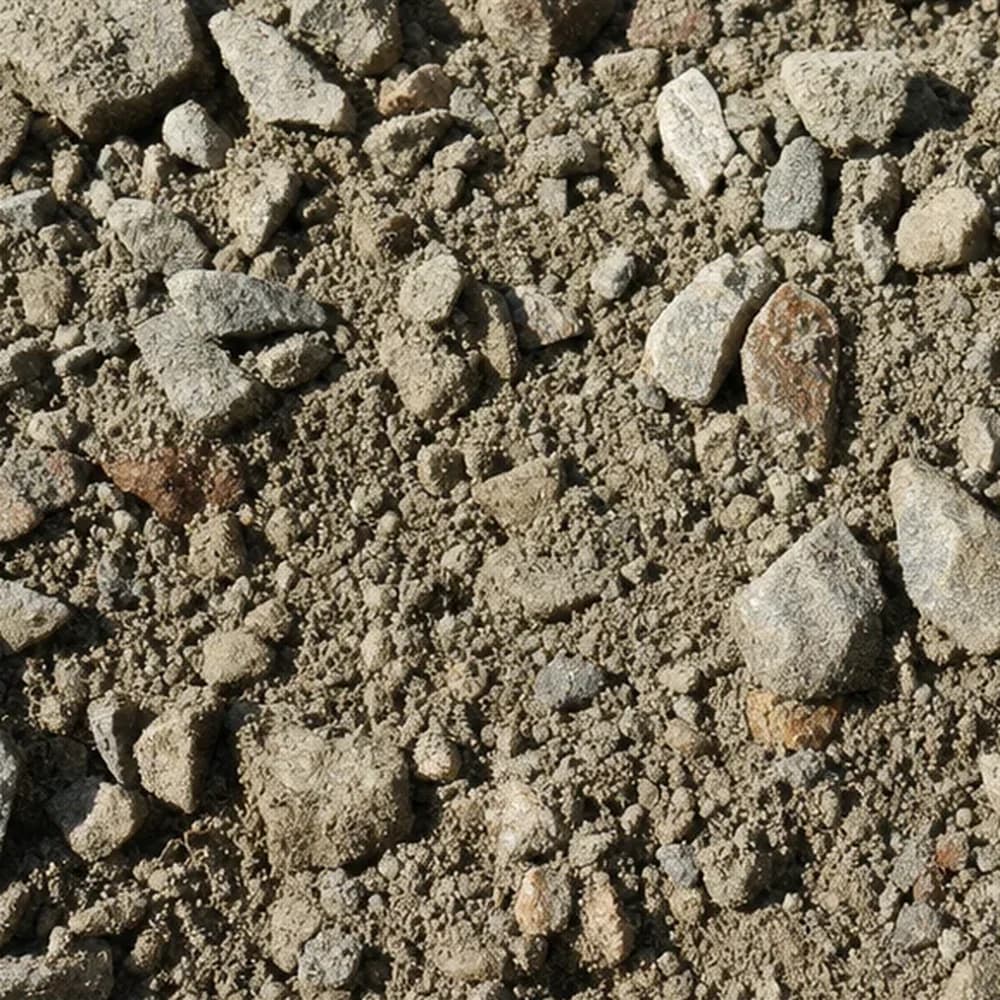
Crusher Run Calculator for a Compacted Massachusetts Base
Enter your project dimensions
Ground work here has a window. It opens when the frost lets go of the till in spring and closes at the first hard freeze in late autumn, and a plate compactor only earns its keep inside it. Order the base in August and there are months of dry weather left to roll it. Order it in November and the tonnage can be right while the result is not.
Numbers first. This site publishes roughly 3,000 lb per cubic yard for crusher run and road base, about 1.50 tons per cubic yard, and that approximate figure is what the tool applies. A 34 by 10 ft in-town driveway at five compacted inches works out just under 8 tons.
One thing to settle before you type anything: crusher run loses about 10 to 15 percent of its height as it is rolled, so the depth that goes in the box is the finished compacted depth, not the loose lift you will be standing next to when the pile lands.
Which surface am I measuring, the lane or the turnaround?
Both, in one pass. Choose rectangle for a straight run, circle for a round pad, or multiple areas when the drive and a parking apron are separate shapes. The tool takes up to five areas and totals them.
Enter length and width in feet, or a diameter for a circle. Measure an old lane at its narrow point and again at its widest, then use the average, because a drive that has spread into the lawn over twenty winters is rarely the same width end to end. On anything over 50 feet a measuring wheel gives a straighter figure than a tape held by one person.
How deep does the base go before the March thaw finds it?
Depth goes in inches, anywhere from 0.25 to 24.
| Job | Finished compacted depth |
|---|---|
| Path, or the layer under pavers | 4 in |
| Car driveway or parking pad | 4-6 in |
| Ground a loaded truck stands on | 6-8 in |
Those figures apply after rolling, not before. On the dense lower till under much of Greater Boston, the Worcester plateau and the western hilltowns, snowmelt perches close to the surface and freeze-thaw lifts whatever is sitting in it, so the upper end of each band is the sensible read. On the outwash sand of Cape Cod, the Islands and the Plymouth and Carver country, water leaves fast and the base is there to spread load rather than to fight water. Silty old lake-bed ground on the Pioneer Valley floor is the frost-susceptible case and wants full depth.
Massachusetts town road standards describe base material by MassDOT section: M1.03.1 processed gravel for subbase, M2.01.7 dense graded crushed stone. Those numbers are how material is specified locally, not a certification held here.
Why does 5.25 cubic yards come back as nearly 8 tons?
Three results appear: cubic yards, tons and cubic feet. Cubic feet is the raw volume, length times width times depth in inches divided by 12. Divide by 27 for cubic yards. Multiply cubic yards by 1.50 for tons.
This blend is heavier per yard than washed stone because the fines fill the voids between the pieces. Rain adds weight again, which changes what a wheelbarrow feels like and changes nothing about what to order. Order on the ton figure and use the yardage when you are picturing the pile.
If you want to check the tool against something, one cubic yard covers 162 sq ft at 2 in, 81 sq ft at 4 in, 54 sq ft at 6 in and 41 sq ft at 8 in.
Should the ten percent stay ticked on a layer that gets rolled?
Yes. Leave it ticked on anything that will be compacted or wheelbarrowed across a lawn. Untick it only where material is going somewhere loose and contained.
Two hypothetical jobs, worked through on one delivery. The 34 by 10 ft drive is 340 sq ft. At five compacted inches: 340 x 5 / 12 = 141.67 cu ft, / 27 = 5.25 cu yd, x 1.50 = 7.87 tons. An 11 by 22 ft apron beside it at six inches: 242 sq ft x 0.5 = 121 cu ft, 4.48 cu yd, 6.72 tons.
Entered as two areas, the totals are 262.67 cu ft, 9.73 cu yd and 14.59 tons. With the ten percent ticked it lands at 10.70 cu yd and 16.05 tons. Order 16.5 and place it in two-inch lifts, misting each one, because damp material tightens where dry material shuffles.
Crusher run, dense grade or processed gravel: which row to pick
They overlap. Most Massachusetts yards sell the compacting stone-and-fines blend as dense grade, and under a town drive or walk the specified layer is processed gravel. This site lists both Crusher Run and Processed Gravel. Pick the one your plan set or your contractor names, because that is the name that has to appear on the ticket when the load arrives.
Where the material belongs does change. Fines are the whole point under a pad, and the reason to keep this blend out of a French drain, where clean 3/4 inch crushed stone does the job instead. A patio is a different build again: size a patio base with its six-inch overhang rather than this page, and the bedding inch that sits above it is a separate order at a separate weight. A rural lane can run on crusher run alone, dusty in a dry July and wanting a regrade every few years, or take two to three inches of driveway gravel as its driving surface.
Booking the load once the number is settled
Open the product page, set the quantity, pick a delivery date and check out. Delivery is arranged at checkout by ZIP code, and the truck needs clear access to the spot you have picked out. If the same job needs loam, mulch or a washed stone as well, every material calculator on the site sits on one page.
Common questions
The drive is still solid underneath and only wants topping up. What depth goes in the box?
Push a stake down through the loose surface until it stops on firm material and measure the difference in inches. That is your depth. On a drive that has held its shape it is usually one to two inches, which means you are renewing a surface rather than rebuilding a base, so compare that number against the driveway gravel route before you order a base blend.
What actually happens if I come up half a ton short?
The last stretch finishes thin, and thin base is where the potholes start after the first thaw. The second problem is timing: a small top-up load usually arrives after the compactor has gone back, so that patch never gets rolled with the rest. Round up to the next half ton.
How close is the estimate to what the job swallows?
The arithmetic is exact and the ground is not. An uneven subgrade, soft spots on wet till and settlement between lifts move the real requirement by roughly ten to fifteen percent, which is what the ten percent tick and sensible rounding are there to absorb.
I have a tonnage. Which product page do I open?
The base blend is Crusher Run or Processed Gravel, whichever name the rest of your plan uses. If the figure you calculated was for a surface course rather than a base, order that layer on its own product page instead.
Fifteen tons on a narrow street. Where does it go?
Pick the spot before you order, not while the truck is waiting. Fifteen tons is a pile you walk around rather than step over, so it wants firm ground, nothing overhead, somewhere that will not block the only parking space, and a position at the far end of the run so the work moves back toward it. Put a tarp down first if it is landing on new concrete.
Related calculators
Base tonnage sorted? Good.
Crusher run by the ton, the cheapest structure on the yard, delivered free.