Road Base Calculator for Massachusetts Lanes, Drives and Pads
Enter your project dimensions
There is a window for this work and it is shorter than people expect. Base goes down once the frost is fully out and the subgrade has dried enough to take a roller, which on dense till in the hilltowns can mean late May, and it has to be rolled and crowned before the ground freezes again in the autumn. Run the road base calculator early, because the tonnage decides whether the job is an afternoon with a box blade or two loads and a rented machine.
Which part of a 300-foot lane goes in the length box?
Measure along the centerline of the lane, not down one edge, and use an average width rather than the widest point. A lane that runs 9 ft through the trees and opens to 12 ft at the top is entered as its average, and the turnaround at the end is a second area rather than extra length.
Multiple areas mode takes up to five of them and adds the volumes together, which is the honest way to handle a drive with a parking apron, a pull-off and a shed approach. Pads are simply length by width. A circle takes a diameter, which is occasionally useful for a turning bulb.
Wheel tracks are a tempting shortcut and a false economy. Base narrower than the traffic breaks along its edges first, and the repair costs more stone than the saving.
How many inches under a fuel truck on ground that stays wet until May?
Depth is chosen for what drives on the surface and for what sits underneath it.
- 4 inches compacted: light residential use, garden access, a shed or store approach.
- 6 inches compacted: daily cars and the delivery and fuel trucks that have to reach the house.
- 8 to 12 inches compacted: soft or wet subgrade, and anywhere a machine or a container will stand.
The subgrade matters more here than the traffic. Dense lower till under most of the state holds snowmelt near the surface into spring, so water perches under the base rather than draining away from it. Silty old lake-bed ground on the Pioneer Valley floor is worse again, because fine silt is highly frost-susceptible and softens as it thaws. Both of those argue for the deeper end. On the outwash sand of the southeast and the Cape, drainage is rarely the problem and depth is about carrying load.
Strip the topsoil before any of it goes down. Stone laid on organic soil pumps mud up through itself no matter how thick it is. On soft or rutted ground, a woven geotextile under the stone separates the two; it is not a product here, so source it locally before the delivery. Roll in lifts of 4 inches or less, and finish with a 2 to 3% crown off the centerline so rain leaves the surface instead of soaking into it.
The yards look small and the tons look big: which do I order on?
Both numbers describe the same pile. Cubic feet is length by width by the depth in inches divided by 12. Divide by 27 for cubic yards. Multiply the yards by the material weight for tons.
Processed gravel and crusher run are published on this site at about 3,000 lb per cubic yard, which is 1.50 tons. That ratio is what makes the tonnage look alarming next to the yardage: a little over 29 cubic yards is 44 tons. Base material is sold by the ton, so the ton figure is the one the order goes on, and the yardage is the one that tells you how much space the pile needs.
A useful cross-check: one ton spread 6 inches deep covers about 36 square feet, and at 4 inches about 54. If the calculator disagrees with a quick count of that kind, the depth box is usually the reason.
What does the 10% add to a lane-sized load?
The control adds 10% for compaction and spillage, and it is on by default, though you can untick it. On a base course it earns its place: stone loses depth as it is rolled, some of every load stays on the tarp, and the wheelbarrow route always takes a share.
On a lane-sized order that 10% is not a rounding error. Forty-four tons becomes 48.4, and about 3 cubic yards of pile with it. Decide before you order rather than after the truck has gone.
A 120-foot lane with a turnaround, and a 9 by 18 fuel-truck pull-off
Hypothetical jobs, worked through.
Lane and turnaround, entered as two areas. The lane is 120 by 10 ft at 6 inches compacted: 1,200 sq ft, so 1,200 x 6 / 12 = 600 cu ft. The turnaround is 24 by 12 ft at 8 inches: 288 sq ft, so 288 x 8 / 12 = 192 cu ft. Together, 792 cu ft. That is 792 / 27 = 29.33 cu yd, and 29.33 x 1.50 = 44.0 tons. With the 10% on, 32.26 cu yd and 48.4 tons.
Fuel-truck pull-off. 9 by 18 ft at 6 inches: 162 sq ft, 162 x 6 / 12 = 81 cu ft, 81 / 27 = 3.00 cu yd, 3.00 x 1.50 = 4.50 tons. With the 10%, 3.30 cu yd and 4.95 tons.
Forty-four tons is not a wheelbarrow job. Budget for a tractor with a box blade or a skid steer, and for a plate or roller to compact each lift.
Is this the same material as the crusher run calculator?
Close relatives, different jobs. Both are crushed stone carrying fines, both compact, and both are figured at 1.50 tons per yard, so the arithmetic is identical.
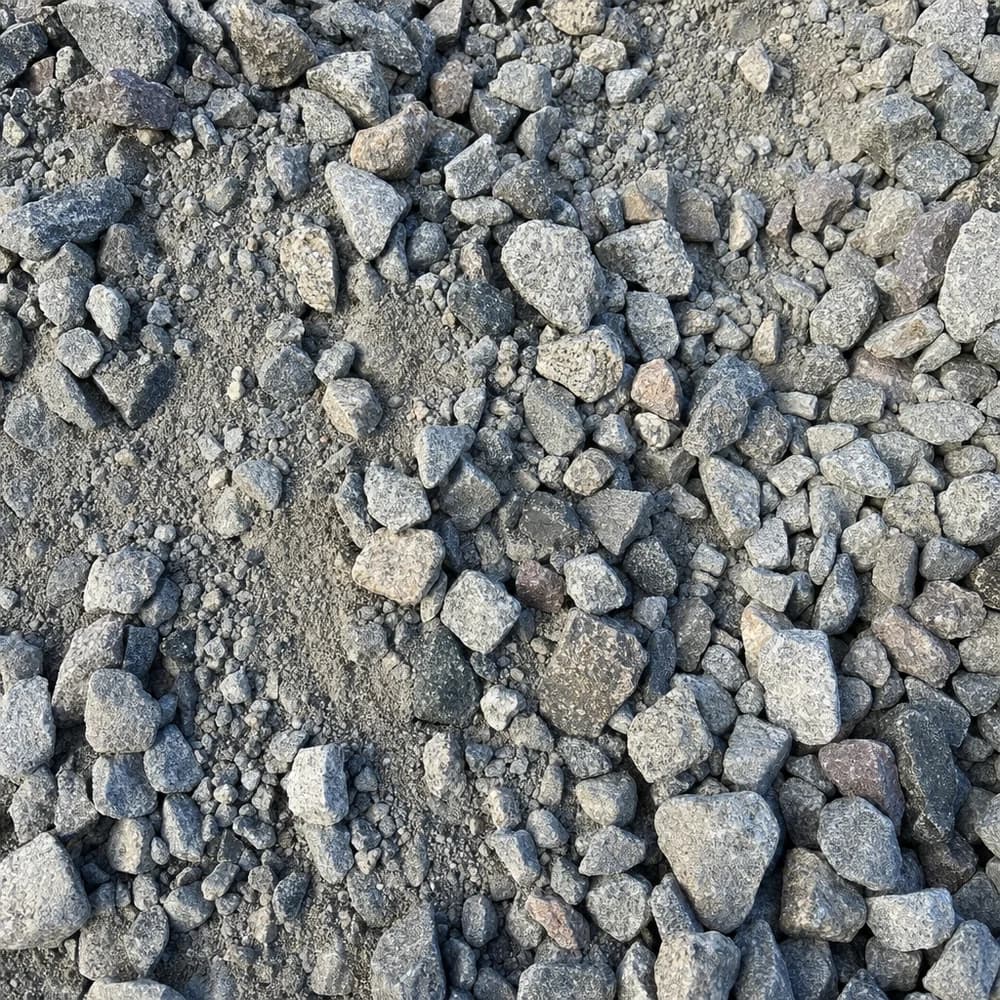
What differs is gradation. Processed Gravel has the larger top stone and is the load-carrying layer under lanes, drives and pads. It is the material Massachusetts jobs are specified around, MassDOT listing it as M1.03.1 processed gravel for subbase, which is how the material is described locally rather than a certificate anyone here holds. Some suppliers sell a similar blend as dense grade.
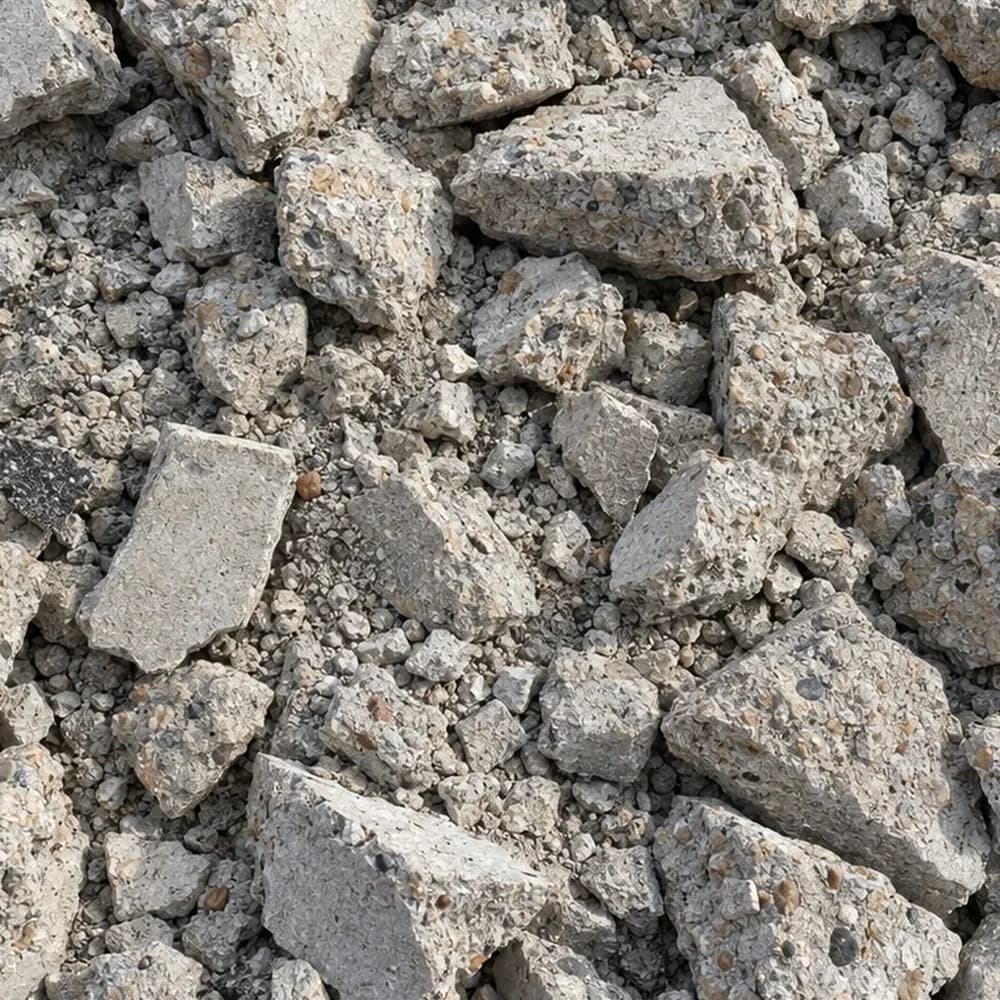
Crusher Run is finer and screeds flatter, which is why it turns up under pavers and close-graded flatwork. If that is the layer you are sizing, the crusher run calculator is the page for it. Either way, a surface course of driveway gravel or #57 goes on top once the base is rolled.
Common questions
Two inches of fresh gravel over a lane that is still firm underneath: what depth is that?
Enter the thickness you are adding, not the base you already have. Two inches of new material across an existing compacted lane is a top-up; a 100 by 9 ft drive at 2 inches works out to 150 cu ft, 5.56 cu yd and 8.33 tons. Grade out the ruts first or the new stone just deepens them.
The forty-four tons runs out before the turnaround is finished. How much does that joint matter?
Bad on a base course, because a lane finished in two stages consolidates unevenly at the joint and the thin section is where it fails. Round up rather than ordering a precise figure, and place the shortfall risk at the end of the run you can most easily reach again.
On till that stays wet until May, will the lane eat more than the paper figure?
The volume arithmetic is exact. The depth you typed is the estimate. A rutted or soft subgrade swallows the first lift, so real consumption commonly runs above the paper figure on wet ground and lands close to it on firm, well-drained ground.
Which product is the six-inch base, and which is the surface course over it?
The base layer is Processed Gravel. If what you sized was the finish course, order Driveway Gravel or 3/4 inch crushed stone instead. Set quantity and a delivery date there, and delivery is arranged at checkout by ZIP code, with the delivery page covering what the truck needs.
Where do forty-plus tons go on a property with one turnaround?
Not in one mountain at the gate. Split a lane-sized order between two drop points along the run so the material is being pushed downhill or on the level rather than uphill. Each spot needs firm ground, clear overhead and room for the truck to back in and tip.
Related calculators
Thirty tons. Zero delivery fees.
Road base priced per ton, hauled free, at lane quantities where hauling usually costs the most.