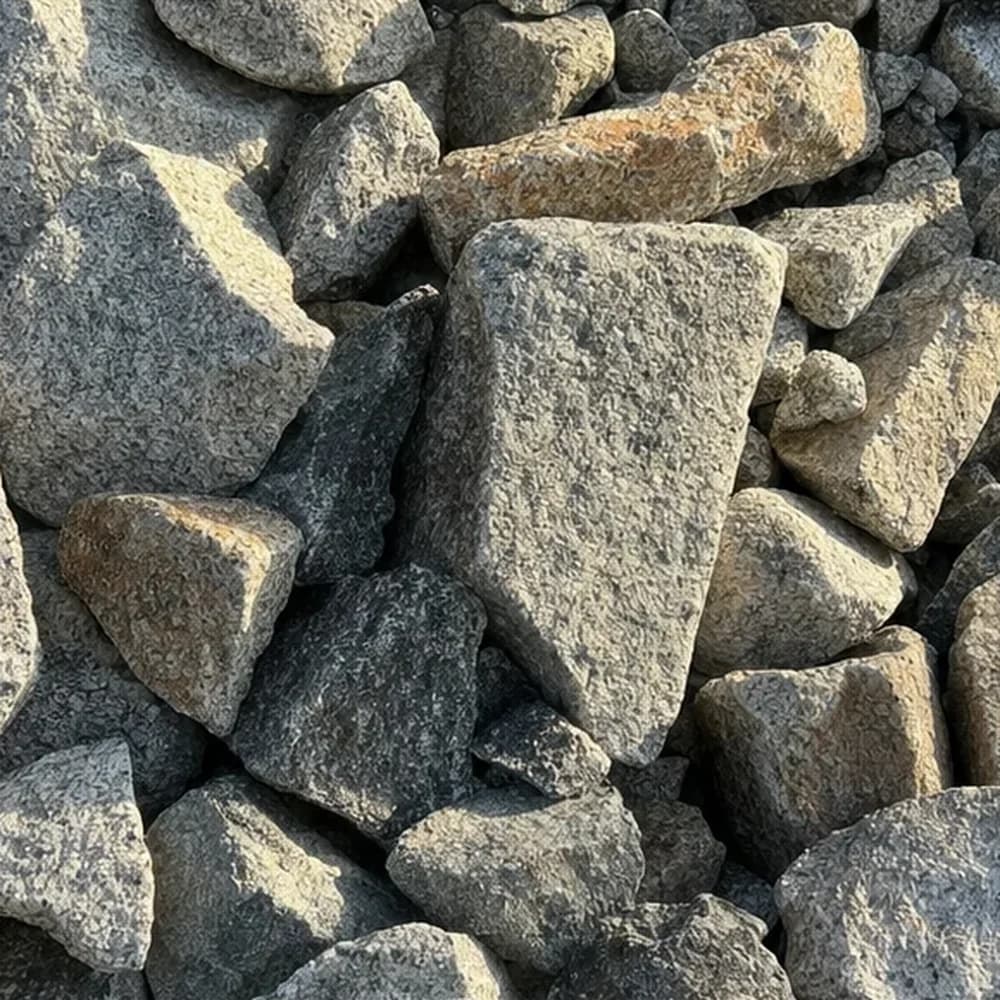
Rip Rap Calculator for Massachusetts Banks and Culvert Outlets
Enter your project dimensions
Almost every order that goes wrong on this rip rap calculator started the same way: a tape run across the level lawn at the top of the bank, and a depth borrowed from a garden path. Both are wrong, and together they can produce an order a fifth of the size the bank needs.
Armor stone is placed in layers of a foot and upward, so a ton covers about seventeen square feet, a square four feet on a side. The same ton spread two inches deep as landscape stone covers well over a hundred. Start from the layer, then the area.
Twelve, eighteen or twenty-four inches: what the water decides
| Job | Stone size | Layer thickness | One ton covers | Tons per 100 sq ft |
|---|---|---|---|---|
| Downspout outlet or small splash apron | 4-8 in | 12 in | approx. 17 sq ft | 5.7 |
| Pond bank or a slow inland stream | 4-8 in | 12-18 in | 17 to 12 sq ft | 5.7 to 8.6 |
| Stream bank scoured by thaw runoff or a hill flood | 8-12 in | 18 in | approx. 12 sq ft | 8.6 |
| Shoreline taking nor'easter surge, or boat wake | 8-12 in | 24 in | approx. 9 sq ft | 11.5 |
The rule behind the table is that layer thickness runs one and a half to two times the largest stone, with twelve inches as the floor for anything doing real erosion work.
Massachusetts gives the page two different problems. On the coast, storm waves and surge from nor'easters work at a shoreline that is mostly eroding over the long term, and that is the case for the larger size class and the thicker layer. Inland, the damage comes after heavy rain and spring thaw, when hill streams rise fast and scour banks and culverts; the flash flooding that went through the northwestern hills during Tropical Storm Irene in 2011 is the extreme version of the same mechanism. Anything engineered, such as a highway embankment or a spillway, comes with its own specified class and depth, and the plan overrides this page.
Measuring down the face of the bank, not across the lawn above it
Run the tape down the slope, from the toe to the top of the protected zone, and multiply that by the length of shoreline or channel you are armoring. A bank five feet down the face reads about four and a half feet from above, and that difference is a tenth of your order, more as the bank steepens.
Enter the slope-face measurement as the width and the run as the length. Shapes are rectangle, circle and multiple areas up to five, so a bank and a separate culvert outlet can be totaled in one pass. Depth goes in inches and the field accepts 0.25 to 24, which covers armor work up to the two-foot layer exactly. For anything deeper, split it into two runs and add the results.
Get the slope itself to 2:1 or flatter before stone goes on it. A steeper bank needs engineering rather than more rock.
Forty feet of scoured bank and a culvert apron, in tons
Two hypothetical jobs, worked through.
A stream bank has lost its toe over two springs. Forty feet of it, with a five-foot slope face, at a fifteen-inch layer of 4 to 8 inch stone:
- 40 x 5 = 200 sq ft of slope face
- 200 x 15 / 12 = 250 cu ft
- 250 / 27 = 9.26 cu yd
- 9.26 x 1.55 = 14.35 tons
Under it goes bedding. Four inches of #4 Crushed Stone over the same 200 sq ft is 66.67 cu ft, 2.47 cu yd, about 3.58 tons at this site's published 1.45 tons per yard for #4 stone, or non-woven geotextile does the same job, bought from a landscape supplier since it is not stocked here. Stone laid straight onto bare soil holds for a season and then settles as the bank washes out from underneath it.
Second job, a 30-inch culvert outlet. The apron runs four to six pipe diameters downstream, so call it fourteen feet long and seven wide, at eighteen inches:
- 98 sq ft x 18 / 12 = 147 cu ft
- 147 / 27 = 5.44 cu yd
- 5.44 x 1.55 = 8.44 tons
Rip rap at 3,100 lb a yard, and the pile that looks too small
This site publishes about 3,100 lb per cubic yard for rip rap and armor stone, roughly 1.55 tons per cubic yard, the heaviest figure in its table. The tool applies that to whatever volume you enter.
Which produces the standard moment of doubt. Fourteen tons of 6 to 8 inch stone is a heap you could walk around in a few paces, and it looks nothing like enough for forty feet of bank. It is, because at fifteen inches deep each ton is only covering about fourteen square feet. The pile is not small; the coverage is.
The same volume in a lighter material returns a smaller ton figure, which is why switching the material select changes the tonnage without changing the cubic yards.
Rounding up when the toe row goes in below the scour line
Round up, and be less shy about it here than anywhere else on this site.
The reason is the toe. The bottom row has to be keyed in below the waterline or the expected scour depth, which uses stone that never shows in the finished face and rarely appears in the measurement either. Riprap failures start at the bottom, so if there is a place for the surplus, that is it.
Before that bottom row goes in below the ordinary high water line of a pond, stream or coastal bank, find out what approval your state and local authorities require. Working in and along water is commonly permitted, and what is asked for is set by the waterbody rather than by the size of the job. The five percent tick is worth using, though on a bank job it is doing less work than a sensible round-up to the next ton.
Hand-place the exposed upper course, or set it with a machine, so pieces key against each other instead of lying where they landed. Then walk the bank after the first big storm and again after the freeze-thaw season, put back anything that has shifted, and check the outlet apron for scour.
One last thing to settle before ordering: the access route. The last twenty feet down to a pond or stream bank is usually soft, and stone that has to be moved twice gets paid for twice in effort. Set the quantity on the RipRap product page, pick a delivery date and check out; delivery is arranged at checkout by ZIP code, and how delivery works covers the access the truck needs at the drop.
If the channel above the bank is a dry creek bed for looks rather than a watercourse under load, that is Large River Rock at a landscape depth, sized on the river rock calculator.
Common questions
What does a six-foot splash patch under a downspout take at the twelve-inch layer?
Use circle mode and enter the diameter in feet. A six-foot circle is about 28 sq ft; at a twelve-inch layer that is 28 cu ft, 1.04 cu yd, roughly 1.6 tons. Small round jobs are where the coverage figure surprises people most, because a ton looks like a lot until it is a foot deep.
What sums sit behind the slope-face tonnage, and is there a faster sense check?
Slope-face area in square feet, times the layer in inches, divided by 12, gives cubic feet. Divide by 27 for cubic yards. Multiply by 1.55 for tons. The quicker sense check is the last column of the table: at twelve inches you need about 5.7 tons per 100 sq ft, at eighteen about 8.6, at twenty-four about 11.5.
Rip rap at 1.55 and river rock at 1.35 over the same layer: why do the tons differ?
Because the tool multiplies the same volume by a different weight. Rip rap is figured at 1.55 tons per cubic yard, crusher run at 1.50, crushed stone and pea stone at 1.40, and river rock at 1.35. The cubic yards stay put, which is the number to compare on if you are weighing up two materials for the same space.
Does the spillage tick cover the toe row keyed in below the scour line?
On a small apron, yes. On a long bank it is thin cover, because the toe row and an uneven face take more than a neat calculation suggests. Treat the tick as spillage allowance and do your real rounding at the ton, adding a ton or so on anything over ten.
The slope face is five feet at the scoured end and shallower upstream. What width do I enter?
Measure the slope face at both ends and at a point in the middle, then use the average as your width. If one section is much steeper, enter it as its own area instead and let the tool add the two together.
Related calculators
Banks don't armor themselves.
RipRap by the ton with free delivery, plus the #4 bedding stone to go under it.