#4 Crushed Stone for Wet Ground in Massachusetts
Massachusetts frost can leave water working below limited excavation, where #4 Crushed Stone provides a freely draining stone course.
- Size: About 3/4 inch to 1-1/2 inches
- Grading: #4
- Type: Angular crushed stone
From $432 for 1 ton, delivery included (larger loads cost significantly less per ton)
Free delivery included
Free delivery anywhere in Massachusetts
Pick a delivery date
Weekday delivery, earliest Oct 30
“Needed crushed stone for my driveway, ordering was simple and the team brought exactly what I ordered.”
Dana T. · Verified Buyer
Get a Free Quote
Fill out the form and our sales team will get back to you within the hour.
Size and Grading
- Size
- About 3/4 inch to 1-1/2 inches
- Grading
- #4
- Type
- Angular crushed stone
The load that most often has to be dug out again on a wet Massachusetts lot is the one that had fines in it. Somebody filled a trench, a wall drain or a soft entrance with whatever compacting blend was already on the property, it packed tight the way compacting blends do, and within two winters the water it was supposed to carry was sitting on top of it instead. That is the failure #4 crushed stone gets bought to repair, and the reason it looks so unfinished compared with the material it replaces.
A pile of pieces the size of a fist that you cannot rake flat
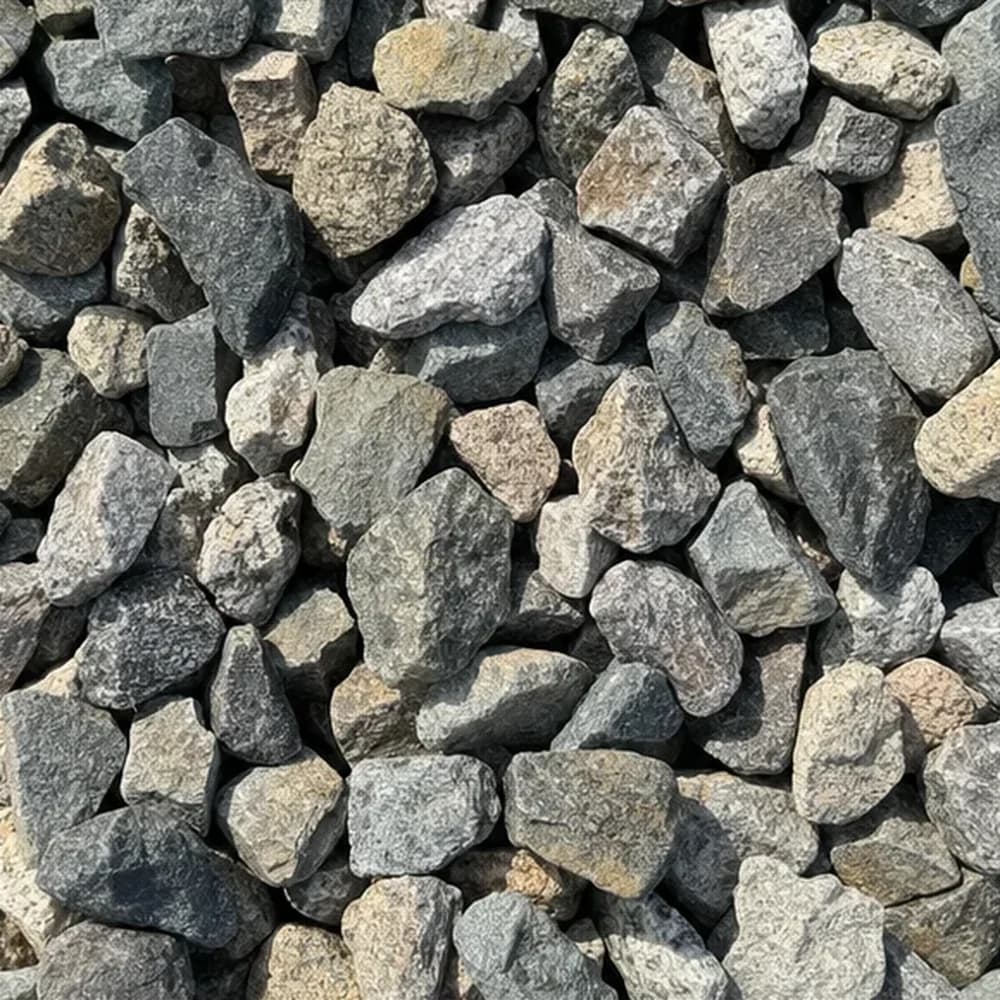
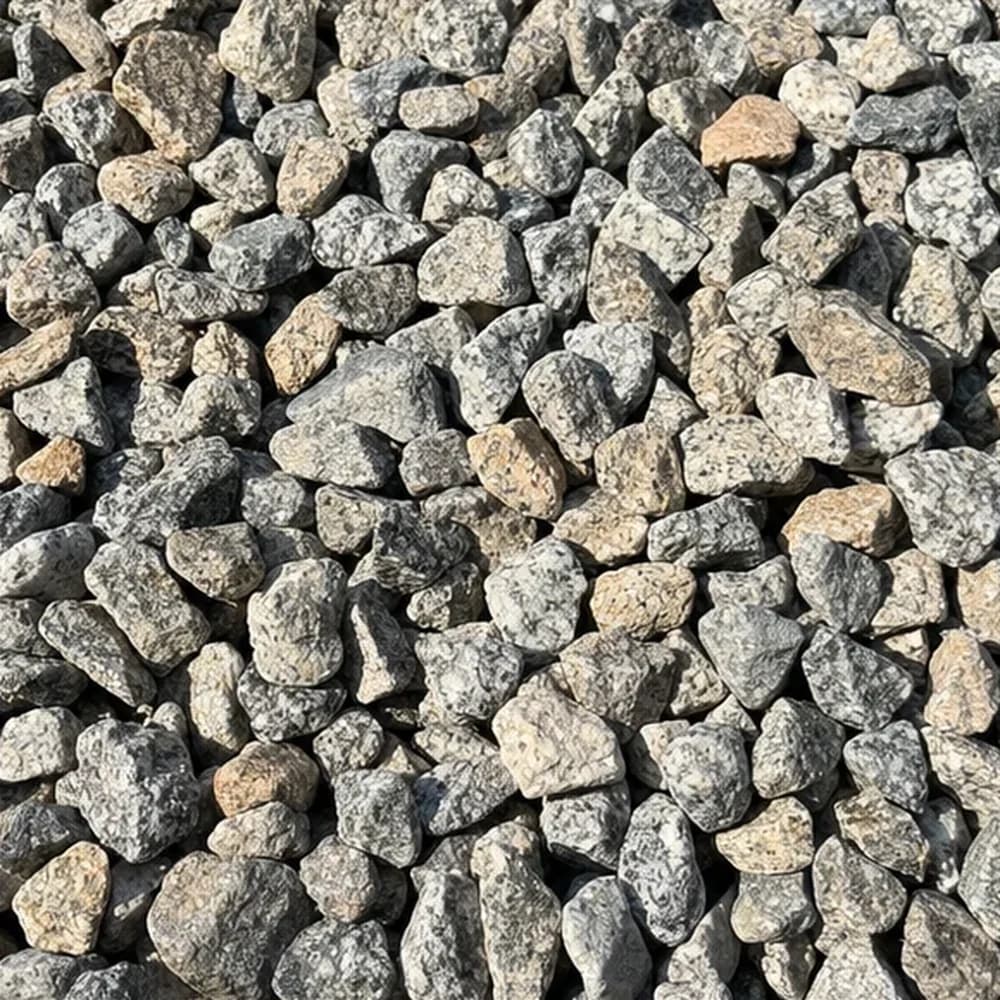
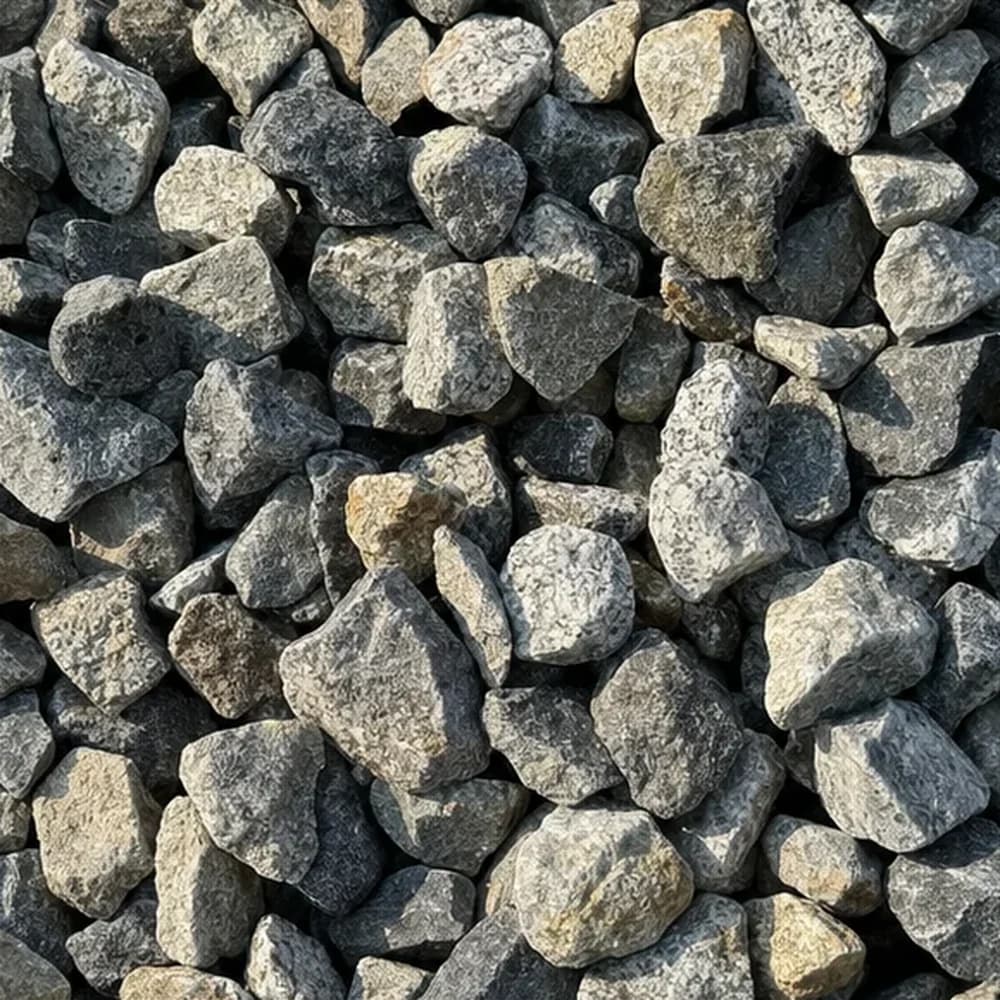
The stone runs roughly 3/4 to 1-1/2 inches, crushed rather than rounded, so every piece has flat faces and sharp corners. Tipped out, it stacks in a loose heap with visible gaps right through it. Rake it and the surface stays lumpy. Walk on it and it rolls under your boot.
That coarse, ungraded look is the performance. Pieces this size leave large permanent voids between them, so water runs through the layer rather than being absorbed by it, and there is no dust in the load to wash down and close those voids later. It is a structural drainage material, not something anyone should expect to finish neatly.
Downspout splash, wall drainage and a bank at the water's edge
A downspout splash area is the smallest of the three and the most common. Concentrated roof water drops onto one spot dozens of times a season, and a splash bed of open stone takes that hit, spreads the flow and lets it into the ground without cutting a channel through the lawn. Keep the bed wide enough that the water lands well inside it.
Retaining wall backfill is the biggest by volume. The drainage chimney immediately behind a wall exists so water can get down and out instead of building pressure against the back of the blocks. Coarse open stone does that and keeps doing it, because there is nothing in the load to migrate into the gaps. Wrap it so soil cannot enter from behind, and give the base of the chimney somewhere to discharge.
A pond or shoreline edge is the third. Stone this size will armor a low bank against everyday wave action and let water pass back through rather than trapping it behind a solid facing. Where the bank is steeper or the water has real force behind it, which is the case along much of the exposed South Coast and on hill streams after heavy rain, step up to RipRap instead.
Where #4 crushed stone is the wrong stone to reach for
It is not a driving surface. Pieces this size will not knit together under tires and they are large enough to chew a mower or catch a plow blade. It is not a path either, and it is definitely not a surface for bare feet or a dog run.
It is also not a leveling layer. Anything laid on top of it needs a finer course in between, because an inch-and-a-half stone leaves hollows nothing will bridge. And it is not the material for a drive base, which wants a blend that compacts: that is Processed Gravel or Crusher Run.
Setting the thickness over slow-draining ground
Depth is driven by what the stone has to move, not by appearance. A downspout splash bed at three to four inches does its job. A drainage course under a pad or entrance is usually built deeper, because it has to keep working after the subgrade has been loaded and worked.
Two things underneath matter more than an inch either way on the depth. On soft or wet subgrade, geotextile between soil and stone is not optional. The dense lower till under most of eastern and central Massachusetts will pump up into open voids under load, and once it has, the layer drains no better than the soil around it. And any buried drainage stone should be wrapped rather than left open to the soil on all sides, because silt entering from the flanks is how these installations fail slowly.
A 30-foot wall drain and a 6 by 8 splash bed, in tons
Hypothetical examples. This site publishes about 2,900 lb per cubic yard for #4 stone and ballast, roughly 1.45 tons per cubic yard, and that approximate figure converts these.
A 30 foot wall drainage chimney, 12 inches wide and 18 inches deep:
- Section: 1 ft x 1.5 ft = 1.5 square feet
- Volume: 30 x 1.5 = 45 cubic feet
- Cubic yards: 45 / 27 = 1.67
- Tons: 1.67 x 1.45 = 2.4
A 6 foot by 8 foot downspout splash bed at 4 inches:
- Area: 6 x 8 = 48 square feet
- Depth: 4 / 12 = 0.333 ft
- Volume: 48 x 0.333 = 16 cubic feet
- Cubic yards: 16 / 27 = 0.59
- Tons: 0.59 x 1.45 = 0.9
A 25 foot pond edge, 4 feet wide and 8 inches thick, sits between them: 100 square feet, 66.7 cubic feet, 2.47 cubic yards, about 3.6 tons. As a rule of thumb for sizing a patch, a cubic yard spread 4 inches deep covers about 81 square feet, and about 54 square feet at 6 inches. For anything with more than one section, the stone calculator adds up to five areas in one run.
Stepping down to #57, or up to ballast and armor stone
The near neighbors are worth knowing. #57 Stone at 3/16 inch to 1 inch is the next size down and the usual pick for pipe surrounds and smaller trenches, where 1-1/2 inch pieces would be clumsy. Railroad Ballast runs coarser again and is built for repeated heavy loading on a site entrance. RipRap is the step beyond that, for banks taking real force. Where the job wants decoration rather than drainage, rounded River Rock looks the part and this stone does not.
Once the tonnage is settled, set a quantity and a delivery date on this page. Delivery is arranged at checkout by ZIP code, and the driver needs a clear, reachable spot to tip.
Quickly Calculate How Much You Need
Material: #4 Crushed Stone
How to Measure
Measure the length and width of your project area in feet
Decide on depth in inches (2" for landscaping, 4" for driveways)
Enter the values above and we'll calculate the tonnage you need
Need help figuring out the right amount? We can help!
Call or text us at (508) 625-9266 and we'll help you calculate the right quantity for your project.
Not sure how much you need? The Stone Calculator has depth guides, coverage charts and worked examples for this material.
Frequently Asked Questions About #4 Crushed Stone
Customer Reviews
Got crushed stone from these guys and it showed up right on time. Free delivery was a nice bonus, 5 out of 5 from me.
Nate D. · Boston, MA · Verified Buyer
Went with this company for crushed stone and ordering was no hassle at all.
Tony D. · Quincy, MA · Verified Buyer
Needed crushed stone for my driveway, ordering was simple and the team brought exactly what I ordered.
Dana T. · Boston, MA · Verified Buyer
Ordered crushed stone from these guys and everything went smooth. Delivery showed up on the day they promised, which made my project way easier. I'd definitely order again and recommend them.
Brian B. · Cambridge, MA · Verified Buyer
Ordered crushed stone from them and the ordering was a breeze. Delivery arrived right on schedule, which made my day a lot easier. Really happy with the whole thing and would definitely use them again.
Pat E. · Lowell, MA · Verified Buyer
#4 Crushed Stone has 5 verified customer reviews with an average rating of 4.8 out of 5.