River Rock Calculator for Massachusetts Beds and Dry Creeks
Enter your project dimensions
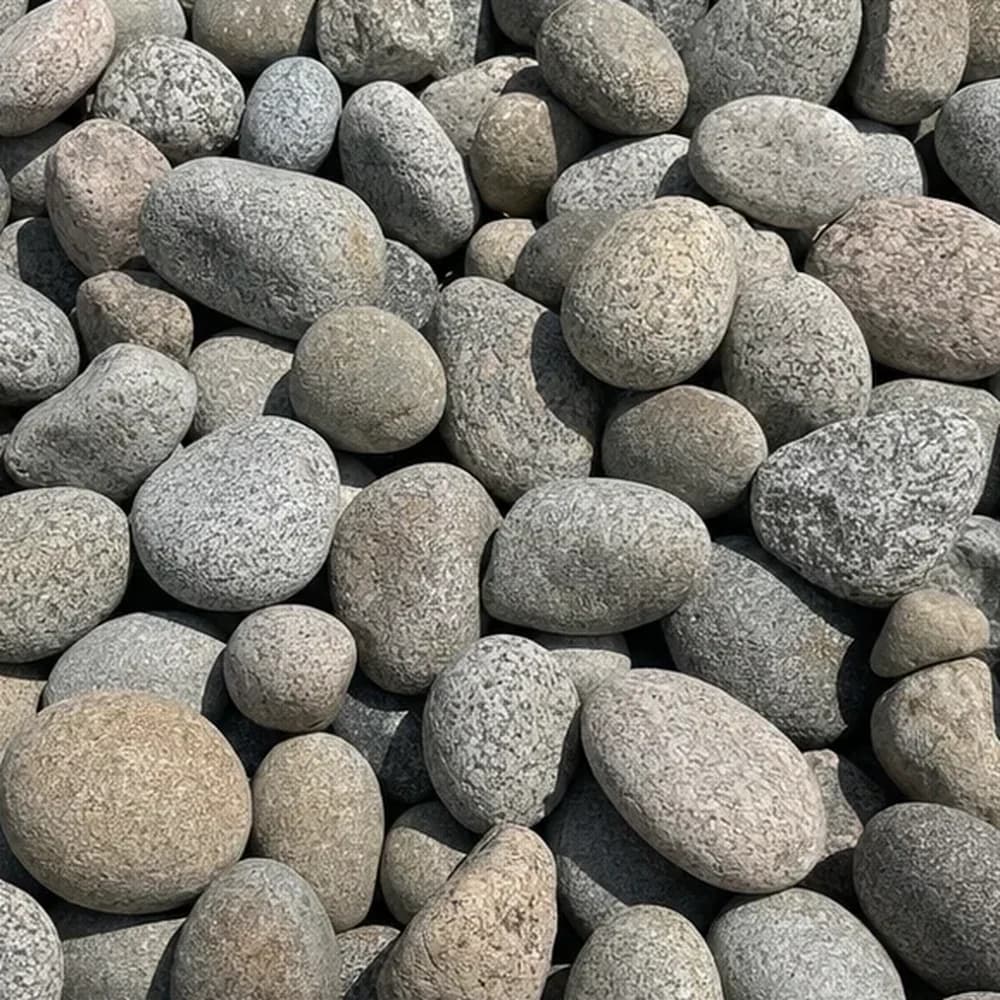
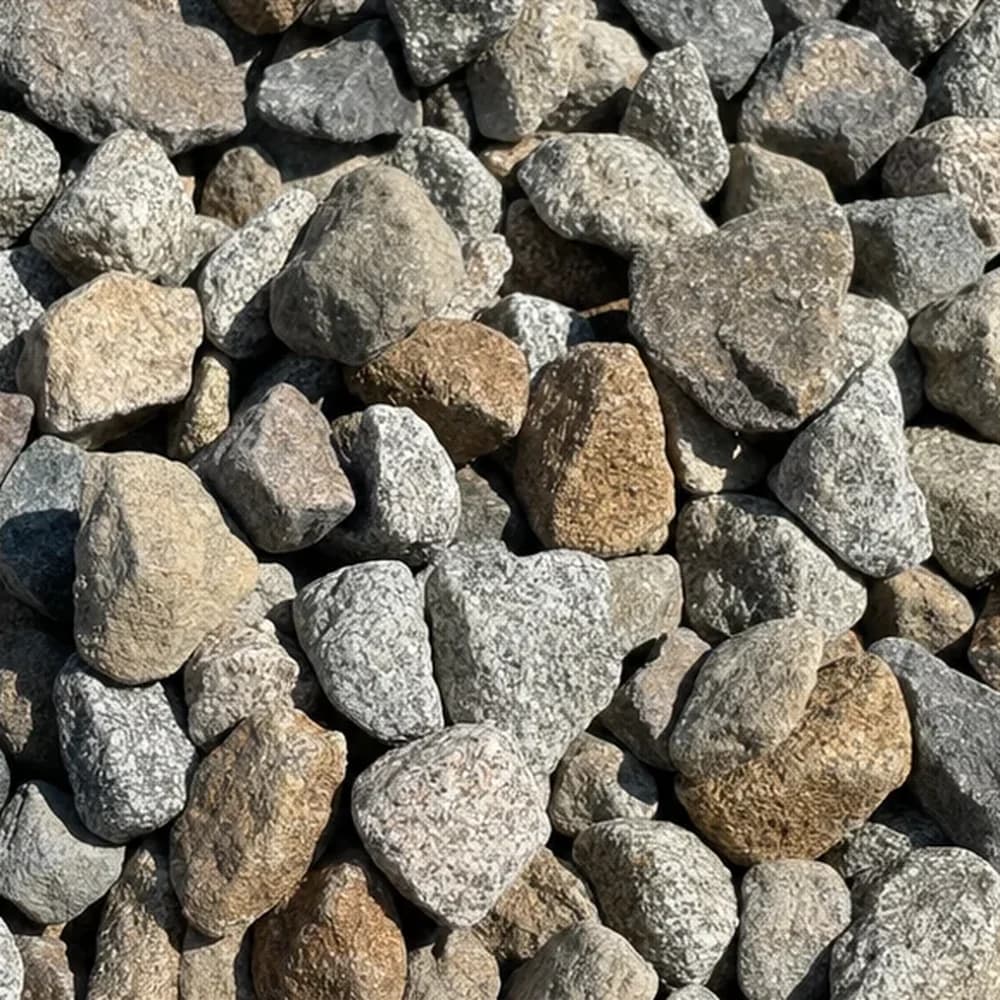
The round stone in a drip edge and the angular stone in the trench three feet away look like one order on paper and never work out as one. Round rock is a surface: it sits in a shallow layer and its job is to look settled. Drain rock and washed crushed stone go deep, inside fabric, and carry water. This river rock calculator sizes the first kind, and the number you put in the depth box decides whether the bed covers the ground or shows fabric by August.
Roof runoff, frost and the layer a rock bed needs here
Most of the state sits on stony glacial till, much of it over a dense lower till that drains slowly. Water off a roof lands on a border bed, soaks in as far as that dense layer, then sits. Through a winter of repeated freeze and thaw it lifts the stone, drops it again, and works the smaller pieces down into the soil beneath. A bed laid thin in April is a bed with bare patches the following spring.
Two habits deal with that. Put non-woven fabric down first and pin it, so the rock has something to sit on other than soil. Then give the layer enough depth to stay opaque after it has settled.
Where the stone is genuinely moving water, at a downspout outfall or in a trench, the fabric wraps around the stone rather than lying under it. That is drainage work, and the sizes for it live on the stone calculator.
On the outwash sand of Cape Cod, the Islands and the Plymouth and Carver plains, frost heave is much less of a problem and rain disappears fast. Depth there is about keeping the bed looking like a bed, and about weight near a shoreline that takes nor'easter spray.
A layer twice the stone diameter, or the fabric shows
A rock bed conceals the ground when the layer runs roughly twice the diameter of the stone in it. That gives three working depths:
| Stone | Layer that covers | What a ton spreads over |
|---|---|---|
| 3/4 to 1 inch round stone | 2 inches | about 120 sq ft |
| 1 to 3 inch river rock | 3 to 4 inches | about 80 sq ft at 3 inches |
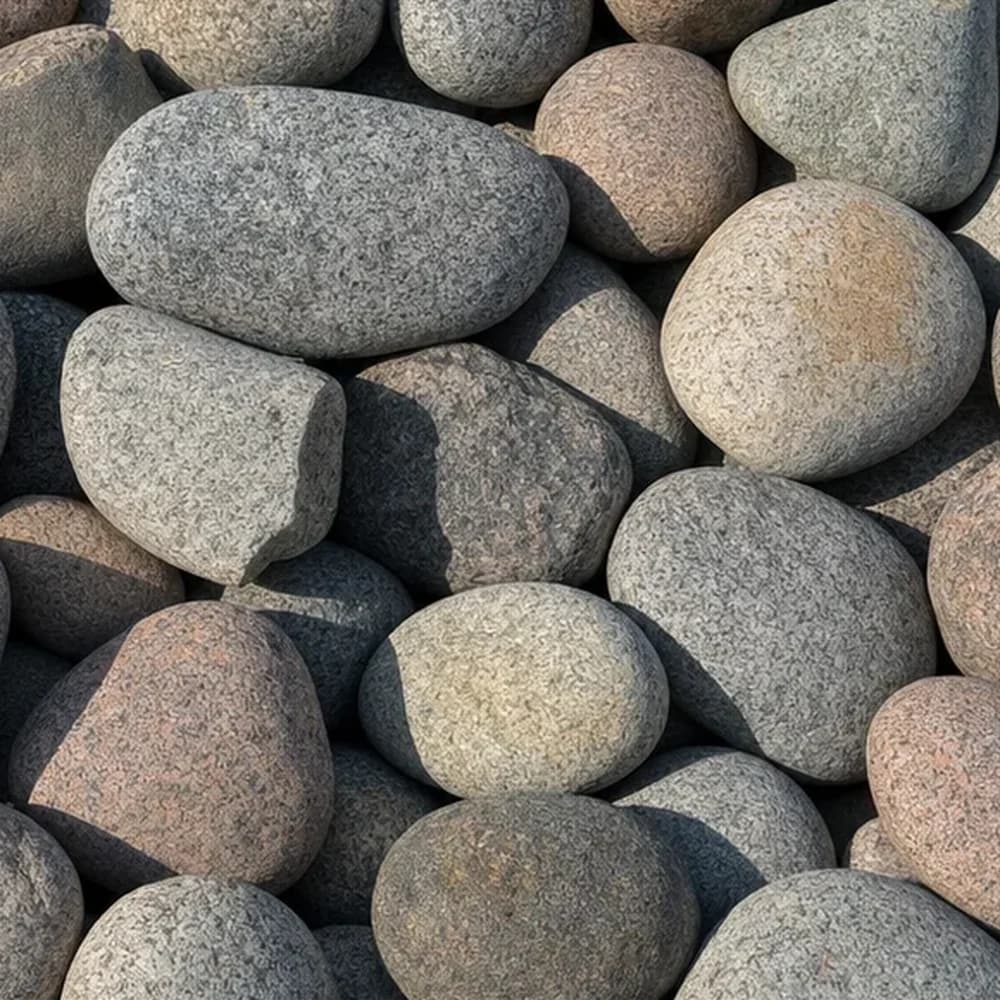
| Large river rock, 2 to 4 inch | 4 to 5 inches | about 53 sq ft at 4.5 inches |
Those coverage figures come out of the weight, not out of a chart. A ton of river rock is about three quarters of a cubic yard, near enough 20 cubic feet. Spread 2 inches deep, 20 cubic feet reaches 120 square feet. Spread 4.5 inches deep it reaches 53. Same ton, less than half the ground.
That is why a delivered pile of round stone looks small. It is a dense material arriving in a shape that hides how far it goes.
Rectangle, circle, or five beds added into one total
Pick a shape first: rectangle, circle, or multiple areas, up to five of them. Length and width go in as feet, and a circle takes its diameter in feet. Depth goes in as inches, anywhere from 0.25 to 24. Choose the material so the right weight is applied, and leave the optional 5% box ticked if you want a margin for compaction and spillage added on top.
Press calculate and three figures come back: cubic yards, tons and cubic feet. There is also a field for an email address if you want the estimate sent over rather than written down.
The yardage holds still, the tonnage does not
Cubic feet is the bed itself: square footage multiplied by the depth in inches divided by 12. Divide that by 27 and you have cubic yards, because a cubic yard is 27 cubic feet. Multiply the yards by the weight of the material and you have tons.
River rock is published here at roughly 2,700 lb per cubic yard, which is 1.35 tons. Run the same bed as pea stone or crushed stone instead and the yardage will not move at all, but the tonnage will, because those sit closer to 2,800 lb. To compare it against pea stone, run the same figures there.
A 46-foot drip edge, four splash pads and a dry creek
Hypothetical jobs, with the arithmetic shown.
Drip edge and splash pads, run as one multi-area calculation. A border 46 by 2 ft at 3 inches is 92 sq ft, so 92 x 3 / 12 = 23 cu ft. Four splash pads at 4 by 3 ft each come to 48 sq ft, so 48 x 3 / 12 = 12 cu ft. Together that is 35 cu ft, which is 35 / 27 = 1.30 cu yd, and 1.30 x 1.35 = 1.75 tons. Tick the 5% and it reads 1.36 cu yd, 1.84 tons.
Dry creek bed. A run averaging 30 by 4 ft, laid 5 inches deep in large river rock, is 120 sq ft: 120 x 5 / 12 = 50 cu ft, 50 / 27 = 1.85 cu yd, and 1.85 x 1.35 = 2.50 tons.
Set the biggest anchor stones about a third of their depth into the ground so the channel reads as something water made rather than something delivered.
Rounding up on a bed nobody wants to reopen
Round the tonnage up. Thin spots show first along the front edge of a bed, which is the edge people look at, and topping up a season later means matching stone that has already weathered.
Think about where the load lands before it arrives. Two tons of round stone is a knee-high pile that needs firm ground, clear overhead and a spot the truck can reach with room to tip. On a tight in-town lot that usually means the driveway apron rather than the back corner, and a tarp underneath saves scrubbing the concrete afterwards.
When the number looks right, open the product page for the size you chose, set quantity and a delivery date, and check out. Delivery is arranged at checkout by ZIP code. If you would rather have a second pair of eyes on the stone size, ask through the contact page before the order goes in.
Common questions
Do I include the granite edging or the border strip in the area I measure?
Measure the ground the stone will actually cover, inside the edging. A cobble or steel border adds an inch or two of width that never receives rock, and on a long thin bed that error runs one way for the whole length.
The bed curves in an arc around a bay window. What do I enter?
Cut it into two or three straight rectangles that follow the curve and enter them as separate areas, or take the average width across the arc and treat the whole thing as one rectangle. Decorative stone is forgiving about a little over.
There is stone there already, just thin. Do I measure the full depth or the shortfall?
The shortfall. Push a screwdriver down to the fabric in four or five places, work out how much is missing on average, and enter that. Rake back what is there before spreading so the new stone does not simply crown over the old.
The trench under the downspout needs stone too. Is that one order or two?
Two rows on the material select, and usually two calculations. The buried stone is drain rock or a washed grade sized on trench volume, and the decorative round stone sits above it. Mixing fines into either one costs you the drainage.
The pile ran out with the far end of the bed still bare. Does that matter?
It leaves a visibly thin section, because the last few wheelbarrows always go where the ground sits lowest. Arranging a second drop for a fraction of a ton is rarely worth anyone's time, so build the margin into the first order instead.
Related calculators
Rock beds are a one-time buy.
River rock, large river rock and drain rock by the ton, free delivery included.