Pea Gravel Calculator for Massachusetts Paths, Beds and Play Areas
Enter your project dimensions
The job that surprises people most on this pea gravel calculator is the play area, so it is worth starting there. A fall zone is deep, and depth is what drives tonnage.
Take a hypothetical 17 by 13 ft area around a swing set, at ten inches of loose stone. That is 221 sq ft.
- 221 x 10 / 12 = 184.17 cu ft
- 184.17 / 27 = 6.82 cu yd
- 6.82 x 1.40 = 9.55 tons
Nearly ten tons for a patch of back garden you could cross in a few paces. Compare it with the stepping-stone strip along the side of the same house, 4 ft wide and 22 ft long at two and a half inches: 88 sq ft, 18.33 cu ft, 0.68 cu yd, about 0.95 tons. Same stone, same site, ten times the quantity, and the only thing that changed was the number in the depth box.
The depth box is where a path and a fall zone part company
Shapes are rectangle, circle or multiple areas up to five, which suits a property where the stone is going in three or four unconnected places. Length, width and diameter go in feet. Depth goes in inches and the field accepts 0.25 to 24.
Depth is where to be deliberate:
| Surface | Depth | What happens |
|---|---|---|
| Path, seating area, dog run, bed | 2-3 in | firm underfoot, and the base stays covered |
| Playground fall zone | 9-12 in | a maintained depth, checked against the equipment manual |
Miss the band either way and you can feel it: below 2 inches the ground shows through within a season, and above 3 inches it walks like dry beach sand.
The only job on this page that goes outside that band is a play surface, and 9 to 12 inches is not a suggestion. At twelve inches, a ton covers about 19 sq ft, so guessing is expensive in both directions. It is worth being clear about what the tonnage buys, too: this is landscape pea stone, it is not sold as certified playground surfacing, and the required depth, the fall-zone footprint and the maintained depth all come from the equipment manufacturer's instructions rather than from us.
Cubic feet, cubic yards, tons: which one the order goes on
Three results come back. Cubic feet is the raw volume. Cubic yards is that divided by 27. Tons is the yardage multiplied by the material weight, and tons is what you order on.
The weight catches people out. Rounded stone looks like it should be light, and this site publishes about 2,800 lb per cubic yard for pea gravel at three eighths of an inch, roughly 1.40 tons per cubic yard, exactly the same figure as angular crushed gravel and #57 stone. The smooth pieces pack together with less air between them than the eye expects.
Coverage, if you want a second check on the tool: one ton spreads across about 116 sq ft at 2 in, 77 sq ft at 3 in, 58 sq ft at 4 in and 19 sq ft at 12 in.
Edging an inch proud, and the wheelbarrow you keep back
Tick the five percent for spillage on anything going into a contained area. On the swing-set example that takes 9.55 tons to 10.03, so order ten and a half.
More useful than the extra percentage is the reserve. Keep a wheelbarrow load in a corner. Rounded stone travels along the line people actually walk, so a path wants raking level twice a year and a bucket or two thrown at the traffic line every couple of seasons. In Massachusetts there is a second thief: a plow blade takes loose stone off a drive edge every winter, and in autumn a leaf blower on full setting takes the rest.
Edging is the thing that decides whether any of this holds. Steel, aluminum, timber or paver edging set an inch above the finished stone surface keeps it in. Edging level with the surface lets the stone walk out over one season. On a slope steeper than about five percent, on the kind of hilly lot that is common here, rain and feet carry the stone downhill regardless, so use a honeycomb stabilizing grid underneath or switch to angular stone that locks together.
Pea gravel, walkway gravel or river rock over the same footprint
Three materials, one footprint, three different answers.
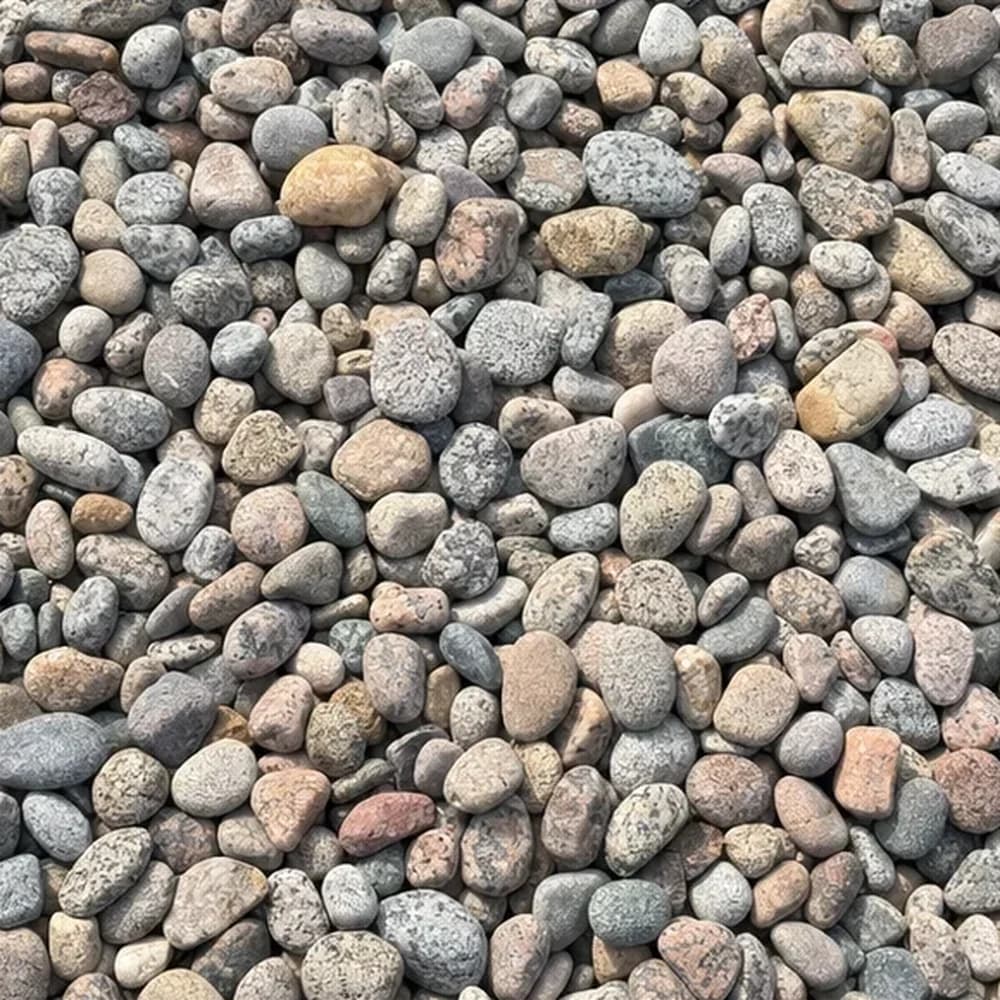
Pea Stone is the softest underfoot and the most likely to move. It is what Massachusetts suppliers mean by pea stone, and it suits a flat garden path, a bed between raised planters, a dog run that gets rinsed off, or that play surface.
Walkway Gravel is angular, so it knits and holds on a slope or a route that takes daily traffic. Size it in the gravel calculator, which uses the same 1.40 tons per yard.
River Rock is larger and decorative, for drip edges, borders and dry creek beds rather than for walking on, and the river rock calculator applies a lighter 1.35 tons per yard. Enter the same dimensions in two tools and the cubic yards will match while the tonnage will not, which is the cleanest way to compare.
A patio takes a two-inch compacted layer of Stone Dust underneath before the pea stone goes down, so that chair legs have something to stand on.
Where ten tons of pea stone can land on a house lot
Ten tons is a real pile, and on a town lot with one driveway that is the constraint worth settling before you order rather than after.
Pick firm ground, nothing overhead, and a spot you can wheelbarrow from without crossing the area you are about to fill. Set the quantity on the product page, choose a delivery date and check out; what happens at checkout is that delivery is arranged by ZIP code, and the truck needs clear access to the spot.
Common questions
The bed is a curve around the corner of the house. How do I measure it?
Break it into pieces. A rectangle for the straight run, a circle for the rounded end, entered as separate areas. Or square the whole thing off at its widest and accept a small over-order, which is not a problem with stone that gets raked and topped up anyway.
The path is still there, just thin and patchy. What depth do I enter?
The difference, not the total. Scrape down to firm material at a few points along the path, measure what is missing in inches, and use the average. A path that has worn through to the base usually wants an inch and a half to bring it back to a walkable three.
What happens if I order half a ton short?
On a path, you finish thin at one end and the ground shows through by the following summer, which is an easy fix with a few more wheelbarrow loads. On a play surface it matters much more, because the fall zone depth is the whole reason the stone is there. Round up.
How accurate is the number?
The volume arithmetic is exact. The looseness is in the ground below: a base that dips, an edge that is not where you measured, and stone that consolidates a little as it is walked on. The five percent tick plus rounding up to the next half ton is a fair allowance on a job this size.
Which product page do I open with the tonnage?
Pea Stone, listed here as 3/8 inch natural pea gravel. If the figure was for the compacted layer under a seating area rather than the surface, order Stone Dust for that layer as a separate line.
Related calculators
Under two tons covers most patios.
3/8 inch natural pea gravel, priced by the ton, delivered free.